10 Effective GEO Strategies to Improve Your Brand Visibility in AI Search Results
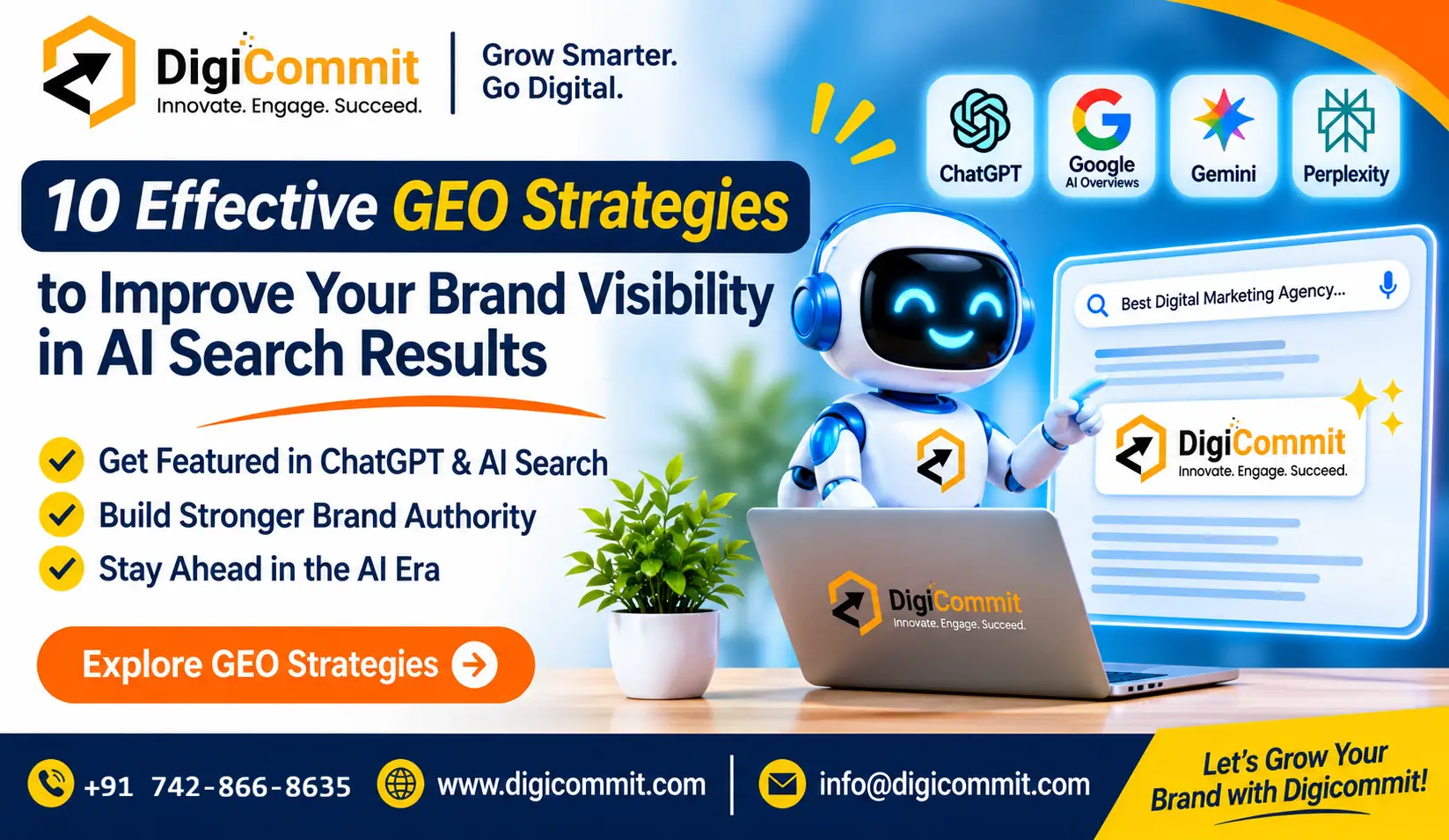
The way people search for information online is changing rapidly. Earlier, users mainly depended on traditional search engines like Google to find websites, products, and services. Today, many people are also using AI-powered platforms such as ChatGPT, Google AI Overviews, Google AI Mode, Gemini, and Perplexity to discover information, compare businesses, and find solutions to their problems.
This change has created a new opportunity for businesses to improve their online presence through Generative Engine Optimization (GEO). GEO focuses on making a brand’s information easier for AI-powered search systems to discover, understand, and potentially reference in their generated answers.
Traditional SEO focuses on improving website visibility in search engine results, while GEO also considers how a business can become a useful and credible source of information in AI-generated responses.
For businesses that want to stay competitive in the digital marketplace, understanding GEO is becoming increasingly important. In this guide, we will explore 10 effective GEO strategies that can help improve brand visibility, strengthen online authority, and reach potential customers through AI-powered search experiences.
What Is Generative Engine Optimization (GEO)?
Generative Engine Optimization (GEO) is the process of improving website content, brand information, and online authority so that AI-powered search platforms can better understand and potentially use your information when generating answers.
For example, imagine someone asks ChatGPT, “Which digital marketing agency offers SEO services for small businesses in India?”
AI-powered search experiences may retrieve information from different websites, business profiles, industry publications, and other online sources to prepare an answer.
If your website provides relevant, accurate, helpful, and clearly structured information, it may have a better opportunity to be considered as a useful source.
GEO is not about finding shortcuts to appear in every AI-generated answer. It is about building a strong digital presence that helps search engines and AI systems understand what your business offers and why your information is valuable.
10 Effective GEO Strategies to Improve Your Brand Visibility in AI Search Results
1. Create High-Quality, Helpful, and Original Content
Content quality is one of the most important foundations of both SEO and GEO. AI-powered search systems need useful information to understand different topics and answer users’ questions.
Publishing generic articles that repeat information already available on hundreds of websites may not help your brand stand out.
Instead, focus on creating original content that solves real customer problems.
For example, if you provide digital marketing services, consider publishing informative articles about:
- How SEO helps small businesses generate organic traffic.
- What is Generative Engine Optimization?
- How can businesses improve their Google Business Profile visibility?
- What is the difference between SEO, AEO, and GEO?
- How can local businesses attract customers through online marketing?
Include practical examples, industry knowledge, useful recommendations, and clear explanations.
The goal should be to provide information that readers genuinely find valuable. Original insights and first-hand experience can help differentiate your website from competitors.
2. Optimize Content for Conversational Search Queries
People interact with AI platforms differently from traditional search engines. Instead of entering only short keywords, users frequently ask complete questions and provide additional context.
For example, traditional searches might include:
- Best SEO agency in India.
- GEO services for businesses.
- Digital marketing company in Noida.
Conversational searches may look like:
- How can a small business improve its visibility in AI search results?
- Which GEO strategies can help a brand appear in ChatGPT responses?
- Why is my website not appearing in AI-generated search answers?
Your content should address these natural questions.
Create dedicated sections that answer common customer queries. Use question-based headings and provide direct, understandable answers.
This approach helps your website cover different search intents and makes information easier for readers to navigate.
3. Use Clear Headings and Structured Content
Content structure plays an important role in making information understandable for both visitors and search systems.
A well-organized article allows readers to find relevant answers without going through long, confusing paragraphs.
Follow these content organization practices:
- Use one clear H1 heading for the main topic.
- Divide the article into relevant H2 sections.
- Use H3 headings for supporting topics.
- Keep paragraphs short and informative.
- Use bullet points for lists and recommendations.
- Add FAQs to address common questions.
- Explain technical terms in simple language.
For example, an article about local SEO can include sections such as “What Is Local SEO?“, “How Does Local SEO Work?”, and “How Can Businesses Improve Local Search Visibility?”
A clear structure improves readability and helps search systems interpret the relationships between different sections.
4. Build Strong Topical Authority Through Content Clusters
Publishing one blog about a topic is not always enough to establish your website as a reliable information source.
Businesses should develop a content strategy that covers their main industry topics in greater depth. This approach is commonly known as topical authority building.
For example, a digital marketing agency can create a content cluster around SEO and GEO.
Main topic: Generative Engine Optimization
Supporting blog topics:
- What Is Generative Engine Optimization?
- SEO vs GEO: Understanding the Key Differences.
- How to Improve Website Visibility in ChatGPT.
- Best GEO Strategies for Small Businesses.
- How AI Search Engines Discover Online Information.
- Why Brand Authority Matters in AI Search.
Connect related articles through relevant internal links.
This helps visitors explore additional information while creating a logical content structure across your website.
A well-developed topic cluster also demonstrates that your business covers a subject comprehensively rather than publishing unrelated articles.
5. Strengthen Your Brand Authority Across the Internet
AI-powered search experiences may use information from multiple sources when preparing answers. Therefore, your brand’s online presence should not depend entirely on your website.
Build a consistent and trustworthy presence across relevant online platforms.
Some useful activities include:
- Publish informative guest articles on relevant websites.
- Participate in industry discussions.
- Get mentioned in relevant business publications.
- Maintain accurate business directory listings.
- Encourage genuine customer reviews.
- Share useful insights through professional platforms.
- Build relationships with relevant industry websites.
For example, if your company offers SEO services, getting mentioned in relevant digital marketing publications can help strengthen your overall online presence.
Focus on genuine industry relevance and quality rather than purchasing random backlinks or creating artificial brand mentions.
Consistent and credible information across multiple sources can help users and search systems better understand your business.
6. Maintain Consistent Brand Information Everywhere
Brand consistency is an important part of building a recognizable online identity.
Your business name, website, services, contact information, business description, and other important details should remain accurate across your digital platforms.
For example, if your company provides SEO, website development, and social media marketing, make sure these services are clearly described on your website and relevant business profiles.
Important places to maintain updated information include:
- Official business website.
- Google Business Profile.
- LinkedIn company page.
- Relevant business directories.
- Social media profiles.
- Industry-specific listings.
Avoid using different business descriptions or conflicting contact details across platforms.
You should also clearly explain what your business does, who it serves, where it operates, and what makes its services different.
Consistent brand information helps establish a clearer digital identity and reduces confusion for potential customers.
7. Improve Technical SEO and Website Accessibility
Even high-quality content needs a technically accessible website.
If search engines cannot properly access, crawl, or index your important pages, your content may have limited opportunities to appear in search experiences that rely on accessible web information.
Review your website’s technical SEO regularly.
Important areas include:
Crawling and Indexing: Check whether important pages can be accessed by search engine crawlers. Review robots.txt, XML sitemaps, indexing status, and accidental noindex directives.
Website Speed: Improve loading performance by optimizing images, reducing unnecessary scripts, and using efficient hosting.
Mobile-Friendly Design: Make sure your website works properly on smartphones and tablets.
Internal Linking: Connect important pages through relevant internal links so visitors and search engines can discover your content.
HTTPS Security: Use a secure HTTPS connection to protect website visitors.
Structured Data: Implement relevant structured data where appropriate and ensure it accurately represents the visible information on your pages.
Remember that technical SEO creates a strong foundation for website visibility. However, technical improvements alone cannot guarantee that your brand will appear in AI-generated responses.
8. Add Reliable Information, Statistics, and Expert Insights
Trust is important when people are looking for information, comparing products, or making business decisions.
Your content should provide accurate information supported by relevant evidence whenever possible.
Instead of making general statements, include:
- Verified industry statistics.
- Original research and survey findings.
- Expert opinions.
- Practical case studies.
- Real business examples.
- Relevant industry reports.
- Links to reliable information sources.
For example, instead of writing “SEO helps every business grow quickly,” explain how organic search can help businesses reach people who are actively looking for their products or services.
If you publish statistics, mention their original source and publication date. Avoid outdated figures or unsupported claims.
Adding genuine expertise and reliable information makes your content more useful to readers and helps establish your brand as a credible industry resource.
9. Optimize Images, Videos, and Other Visual Content
Modern online search is not limited to written content. Images, videos, and other visual formats also help users understand information.
Businesses should include relevant visual content to make their websites more informative and engaging.
Consider these practices:
- Use original and relevant images.
- Write descriptive image alt text.
- Add meaningful image file names.
- Compress images without reducing quality unnecessarily.
- Create informative videos around customer questions.
- Add captions or transcripts to important videos.
- Use clear titles and descriptions for visual content.
For example, a digital marketing agency can publish a short video explaining how businesses can improve their Google Business Profile visibility.
Similarly, an infographic comparing SEO and GEO can help readers understand the differences quickly.
Visual content should support the main topic rather than simply fill empty space on a webpage.
10. Track AI Search Visibility and Improve Your Strategy
GEO is an ongoing process. Publishing optimized content is only one part of the strategy. Businesses should also evaluate whether their brand is becoming more visible across relevant AI-powered search experiences.
Start by preparing a list of questions that potential customers might ask AI platforms.
For example:
- Which digital marketing agencies offer SEO services in Noida?
- How can I improve my website’s visibility in ChatGPT?
- What are the best GEO strategies for small businesses?
- Which agency provides SEO and website development services?
Test relevant questions across different AI search platforms and record:
- Whether your brand is mentioned.
- Whether your website is cited.
- Which competitors appear.
- Which external sources are referenced.
- Whether the information about your business is accurate.
- Whether AI-generated answers describe your services correctly.
You can also monitor website performance through Google Search Console, analytics tools, referral traffic reports, and keyword tracking platforms.
Use these findings to identify content gaps, update outdated pages, improve brand information, and create more useful resources.
Remember that AI-generated answers can change depending on the question, platform, available sources, and time. GEO visibility is not a guaranteed or fixed ranking position.
What Is the Difference Between SEO and GEO?
SEO and GEO have related goals, but they focus on different search experiences.
| SEO | GEO |
|---|---|
| Focuses on search engine visibility. | Focuses on visibility in AI-generated answers. |
| Targets relevant search queries and keywords. | Targets questions, topics, and contextual information. |
| Aims to improve organic search rankings. | Aims to improve opportunities for brand mentions and citations. |
| Uses technical SEO and content optimization. | Builds on SEO with clear, credible, and useful brand information. |
| Tracks rankings, impressions, clicks, and traffic. | Tracks AI mentions, citations, recommendations, and referral activity. |
Businesses should not treat SEO and GEO as competing strategies. A strong SEO foundation supports a broader approach to improving visibility across traditional and AI-powered search experiences.
Common GEO Mistakes Businesses Should Avoid
While implementing GEO, businesses should avoid practices that can reduce content quality and credibility.
Some common mistakes include:
- Keyword Stuffing: Repeating the same keywords unnecessarily makes content difficult to read.
- Publishing Generic AI Content: Producing large amounts of repetitive content without adding original value can weaken website quality.
- Ignoring Technical SEO: Important content must remain accessible and discoverable.
- Using Inaccurate Information: Incorrect statistics and unsupported claims can damage brand credibility.
- Creating Unnatural Brand Mentions: Artificial mentions and irrelevant backlinks do not establish genuine authority.
- Ignoring Content Updates: Outdated information can reduce usefulness for readers.
- Expecting Immediate Results: GEO requires consistent content development, technical improvements, and brand-building activities.
Focus on long-term digital visibility rather than shortcuts or guaranteed AI rankings.
Frequently Asked Questions
1. What is GEO in digital marketing?
GEO stands for Generative Engine Optimization. It is the practice of improving website content and brand information so that AI-powered search systems can better discover, understand, and potentially reference a business in generated responses.
2. How is GEO different from traditional SEO?
Traditional SEO focuses on improving website visibility in search engine results, while GEO focuses on improving opportunities for a brand to be mentioned or cited in AI-generated answers. Both approaches benefit from useful content, technical accessibility, and a trustworthy online presence.
3. Which platforms should businesses consider for GEO?
Businesses can consider AI-powered search experiences such as ChatGPT, Google AI Overviews, Google AI Mode, Gemini, and Perplexity. Each platform may use different systems and sources to generate responses.
4. Does GEO replace SEO?
No. GEO does not replace traditional SEO. SEO remains an important foundation for improving website accessibility, content quality, and search visibility. GEO expands the focus to AI-powered discovery and generated answers.
5. How long does GEO take to show results?
There is no fixed timeline for GEO results. Visibility depends on several factors, including website quality, content relevance, technical accessibility, brand authority, competition, and how different AI platforms retrieve information.
6. Can small businesses benefit from GEO?
Yes. Small businesses can use GEO to strengthen their online presence by publishing helpful content, maintaining accurate business information, building relevant industry mentions, and answering common customer questions.
Conclusion
Generative Engine Optimization is becoming an important part of the changing digital marketing landscape. As more people use AI-powered platforms to discover information, compare services, and find businesses, brands need to think beyond traditional search engine rankings.
Creating original content, answering conversational queries, building topical authority, maintaining consistent brand information, improving technical SEO, and monitoring AI search visibility are important steps toward a stronger digital presence.
However, successful GEO is not about manipulating AI systems or guaranteeing a place in generated answers. It is about making your business more informative, credible, accessible, and valuable to your target audience.
If you want to improve your website’s search visibility, build brand authority, and prepare your business for the future of AI-powered search, Digicommit can help you develop effective SEO and GEO strategies tailored to your business goals. From website optimization and content marketing to digital brand visibility, Digicommit focuses on building a strong online presence that connects businesses with their potential customers. Visit Digicommit today to explore digital marketing solutions for your business.
Related Post

Digital Marketing Strategies to Grow Your Business Online
In today’s competitive online marketplace, having a digital presence is no longer…

How Digital Marketing Services in Noida Help Businesses Grow Online
Digital marketing services in Noida help businesses improve their online visibility, attract…