
AI SEO: How Artificial Intelligence Is Changing Search Optimization
AI SEO Services are transforming the way businesses approach search engine optimization. Search engine optimization is constantly evolving. What worked for websites a few years ago may not deliver the same results today. Search engines are becoming more sophisticated, and artificial intelligence is playing a major role in how search results are generated, ranked, and presented to users. From understanding search intent to analyzing content quality and improving user experience, AI is changing almost every part of modern SEO. Businesses that want to maintain strong online visibility need to understand how artificial intelligence is influencing search optimization and how they can adapt their SEO strategies. This is where AI SEO Services can help businesses create smarter, more effective, and data-driven search optimization strategies.
What Is AI SEO?
AI SEO refers to the use of artificial intelligence, machine learning, automation, and advanced data analysis to improve a website’s visibility in search engines.
Traditional SEO often requires marketers to manually perform tasks such as keyword research, competitor analysis, content planning, technical audits, and performance monitoring. AI can support these activities by processing large amounts of data quickly and identifying patterns that may be difficult to discover manually.
AI does not replace SEO professionals. Instead, it provides valuable insights and automation that can help SEO teams make better decisions and work more efficiently.
How Artificial Intelligence Is Changing SEO
Artificial intelligence is influencing SEO in several important ways. From search engine algorithms to content creation and user behavior analysis, AI is making search optimization more intelligent and user-focused.
1. Better Understanding of Search Intent
One of the biggest changes brought by AI is the ability of search engines to understand what users actually mean when they search for something.
Previously, SEO strategies often focused heavily on exact-match keywords. Today, search engines can understand context, relationships between words, and the intent behind a query.
For example, someone searching for “best website development company” may not simply want a list of companies. They may be looking for information about services, pricing, expertise, experience, or how to choose the right provider.
AI helps search engines understand these different aspects of search intent and provide more relevant results.
Businesses therefore need to create content that answers the user’s actual question rather than simply repeating keywords.
2. Smarter Keyword Research
Keyword research remains an important part of SEO, but AI is making the process more advanced.
AI-powered tools can analyze search patterns, related queries, user behavior, competitors, and content trends to identify relevant keyword opportunities.
Instead of targeting only one primary keyword, businesses can build topic clusters around a broader subject. This allows websites to cover a topic comprehensively and potentially rank for multiple related searches.
For example, a business targeting “AI SEO services” could also create content around AI-powered keyword research, AI content optimization, search intent, technical SEO, AI search engines, and SEO automation.
This broader approach can help establish topical relevance and improve organic visibility.
3. More Effective Content Optimization
AI can analyze existing content and identify opportunities to improve its relevance, structure, readability, and topical coverage.
For example, AI-supported SEO analysis can help identify:
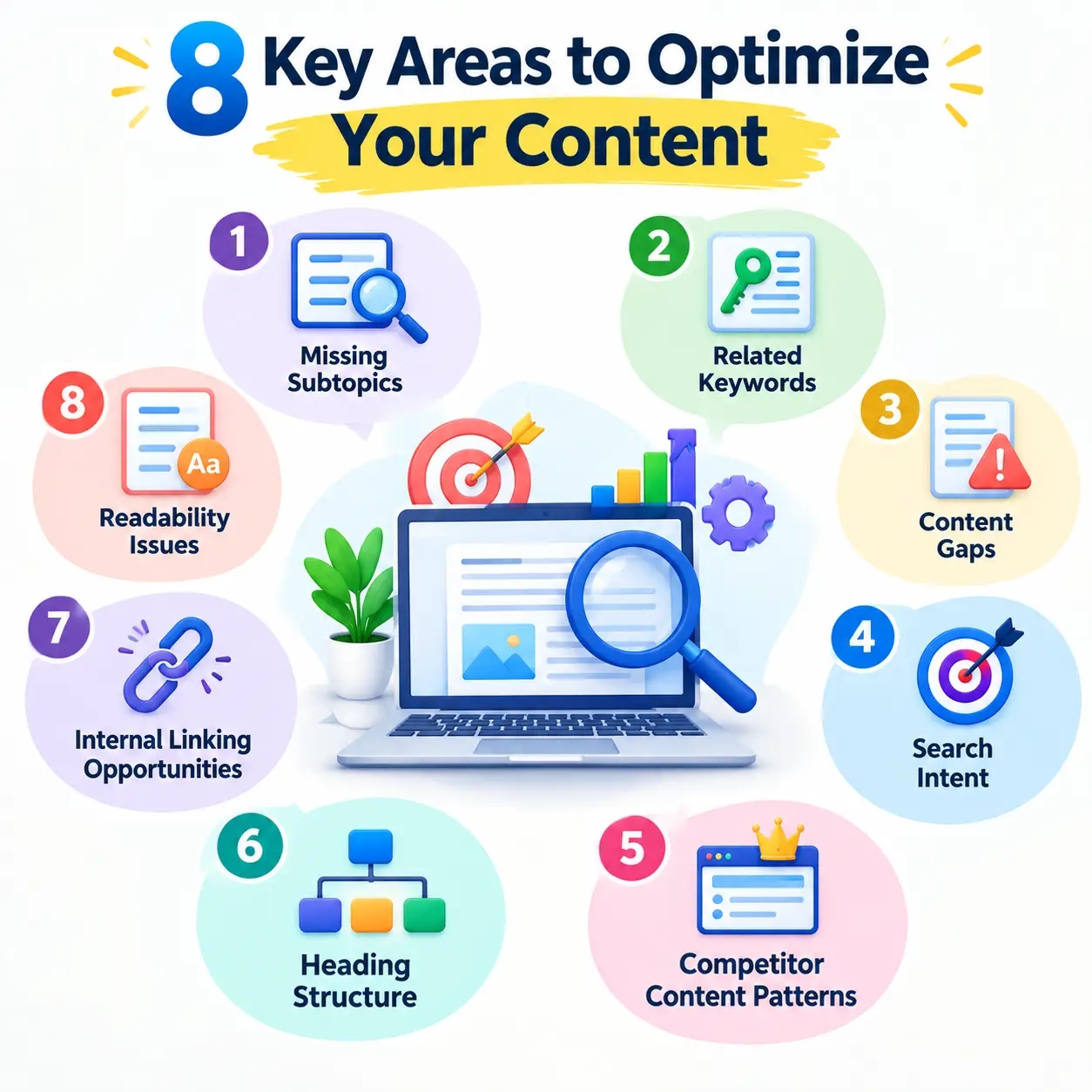
However, simply using AI to generate large amounts of content is not an effective SEO strategy.
High-quality content still needs human expertise, originality, accuracy, useful information, and a clear understanding of the target audience.
The best approach is to use AI as a support system while maintaining human oversight and editorial quality.
4. AI Is Improving Technical SEO
Technical SEO involves many elements that influence how search engines crawl, understand, and index a website.
AI can help SEO professionals identify potential technical issues more efficiently. These may include broken links, duplicate content, indexing problems, missing metadata, page performance issues, and other optimization opportunities.
AI-powered analysis can process large websites and highlight patterns that may take significantly longer to identify manually.
This allows businesses to spend more time implementing improvements rather than manually reviewing every page.
5. Personalized Search Results
Search engines increasingly aim to provide results that are relevant to individual users and their specific queries.
Artificial intelligence helps search systems understand context and deliver more useful information.
This means businesses should focus on creating content for real users rather than optimizing pages exclusively for search engine algorithms.
Content should answer questions clearly, provide genuine value, demonstrate expertise, and make it easy for visitors to find the information they need.
6. AI and Voice Search Optimization
Voice search has also changed how people interact with search engines.
Users often use conversational phrases when searching through voice assistants. Instead of typing short keywords, they may ask complete questions such as “Which is the best digital marketing agency in Noida?”
AI helps search engines understand these conversational queries and match them with relevant content.
Businesses can prepare for this shift by creating FAQ sections, answering common customer questions, using natural language, and targeting long-tail search queries.
7. AI-Powered Competitor Analysis
Understanding competitors is an important part of SEO. AI can make competitive research faster by analyzing competitor websites, content, keywords, backlinks, and search visibility.
This information can help businesses identify:
- Keywords competitors are ranking for
- Topics they have covered
- Content gaps
- Potential backlink opportunities
- Areas where competitors have stronger visibility
- Opportunities to create better and more useful content
The goal should not be to copy competitors. Instead, businesses can use these insights to develop a stronger and more valuable SEO strategy.
8. Predictive SEO and Data-Driven Decisions
One of the most exciting applications of AI in SEO is predictive analysis.
AI can process historical data and identify patterns that may help marketers understand potential changes in search performance.
For example, businesses can analyze traffic trends, keyword movements, user engagement, and content performance to identify opportunities before they become obvious.
While predictions are never guaranteed, data-driven insights can help SEO professionals make more informed decisions.
Why Businesses Need AI SEO Services
As search engines become more intelligent, businesses need SEO strategies that are flexible, data-driven, and focused on user intent.
Professional AI SEO services can help businesses combine traditional SEO practices with artificial intelligence to improve research, content optimization, technical analysis, competitor research, and performance monitoring.
Instead of relying solely on manual processes, businesses can use AI to identify opportunities faster and make SEO workflows more efficient.
However, successful AI SEO requires the right balance between technology and human expertise. AI can analyze data and automate tasks, but strategic thinking, creativity, industry knowledge, and quality control remain essential.
How to Choose the Right AI SEO Agency
Choosing the right AI SEO agency is important because not every business needs the same SEO strategy.
Before selecting an agency, consider its experience, SEO approach, technical expertise, reporting process, content strategy, and understanding of your industry.
A good agency should focus on sustainable organic growth rather than shortcuts or practices that could put your website at risk.
Look for an agency that combines AI technology with proven SEO fundamentals, including technical SEO, quality content, keyword research, local SEO, website optimization, and performance tracking.
The Future of AI and SEO
The future of SEO will continue to be influenced by artificial intelligence. Search engines will become better at understanding context, intent, language, and user needs.
For businesses, this means SEO will become less about simply ranking for individual keywords and more about demonstrating expertise, relevance, trust, and usefulness.
AI will continue to support marketers with faster research, deeper data analysis, improved automation, and smarter optimization. Businesses that adapt to these changes while maintaining high-quality content and strong user experiences will be better positioned for long-term search visibility.
Also Read: Digital Marketing Strategies to Grow Your Business Online
Final Thoughts
Artificial intelligence is not replacing SEO; it is transforming how SEO is planned, implemented, and measured. From keyword research and content optimization to technical SEO and competitor analysis, AI provides businesses with powerful tools to improve their search strategies.
The key is to use AI intelligently. Businesses should combine technology with human expertise to create helpful, original, accurate, and user-focused content.
If you are looking for a digital marketing agency in Noida that can help your business adapt to the changing digital landscape, DigiCommit is the best digital marketing agency in Noida, offering comprehensive digital marketing, SEO, social media, advertising, branding, and website development solutions designed to strengthen your online presence and support long-term business growth.
Related Post

Local SEO: How to Get Your Business Found on Google…
When people need a nearby restaurant, doctor, salon, repair service, or other…